Snow depth fills in from a weather model when the page loads; without it, see the webcams and road noticesWeather-model snow depth at the two ski stations · how it reads · checked in Catania
Snow depth at both ski stations, read when you open the page
Is there snow on Etna today?
The strip above reads the snow at Etna's two ski stations: Rifugio Sapienza on the south side and Piano Provenzana on the north. Below it: whether you can ski, when the snow comes, what the roads ask of your car, and the guided treks that walk on it.
Snow up top: walk on it with a guide
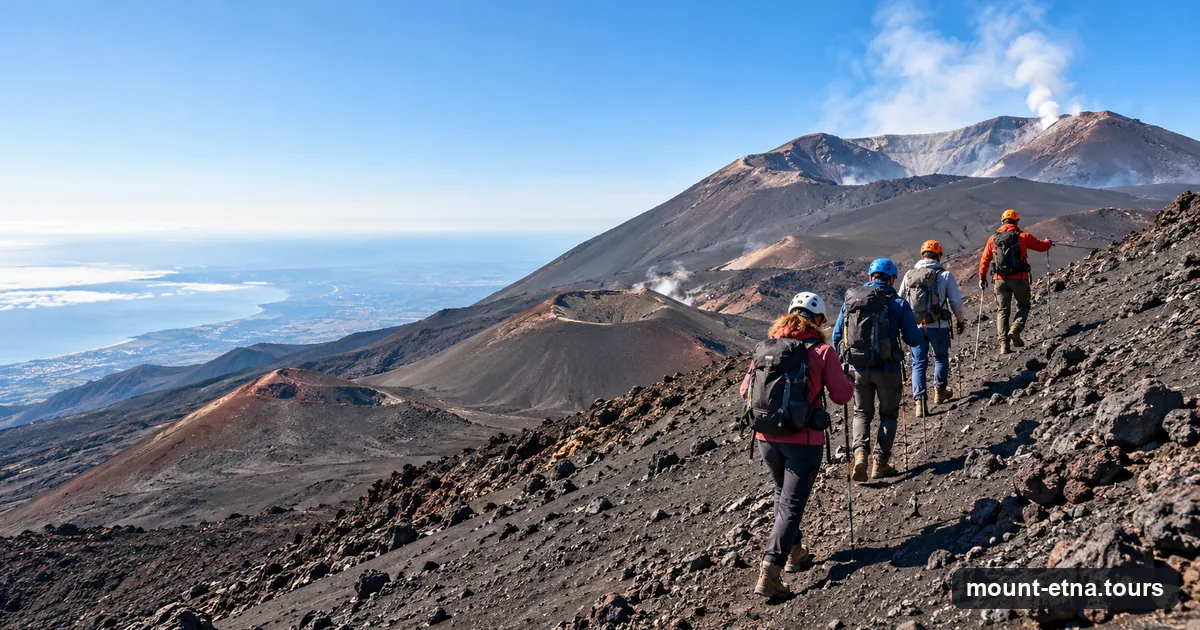
When snow lies at the stations, the guided winter treks walk on it. The high-altitude winter trek from Rifugio Sapienza rides the cable car to 2,500 m and walks to about 3,000 m over long stretches of snow, past the cone of the 2001 eruption, the rim of the Valle del Bove and the Barbagallo craters. Boots, a helmet, poles and the snow gear, crampons included, come with the tour; the cable car, €54, is paid on the day. It is built for experienced hikers, groups are small, and ice can change the route or cancel the day. From €90 a person as of October 2026.
Book Your Experience
Check Availability & Prices
Dates for the high-altitude winter trek from Rifugio Sapienza. Cancel up to 24 hours in advance for a full refund.
Three ways onto winter Etna
The summit trek is the hard version. Two easier days walk the snow lower down, one on each side of the mountain:
High-altitude winter trek, south side
Cable car to 2,500 m, then on foot to about 3,000 m on snow, with crampons and a helmet provided. For experienced hikers; the €54 cable car is extra.
Check dates →The 2002 craters from Piano Provenzana
Three hours from the ski station to the craters of the 2002 eruption. From December to March snowshoes rent on site for €12; you drive up yourself.
Check the trek →Half-day morning trek from Taormina
About an hour and a half on foot round old craters at about 2,000 m, a lava cave, then lunch and almond wine. Boots, a jacket and, in winter, snowshoes are in the kit.
Check the day →GetYourGuide prices, ratings and review counts read in October 2026; operators price by season, so read them as the shape of the market, not a quote.
Two more go out on the snow by design. The winter trek from Rifugio Sapienza with an optional Catania transfer includes snowshoes, a wind jacket and poles for three hours toward the Valle del Bove and the Silvestri craters, from €49. On the north side, the snowshoe trek from Piano Provenzana starts in the snowy forest at 1,800 m and walks 5 km there and back, 300 m of climbing, to the big side craters of the north flank, from €38, with snowshoes and poles rented on site for €12 (October 2026).
Can you ski on Etna?
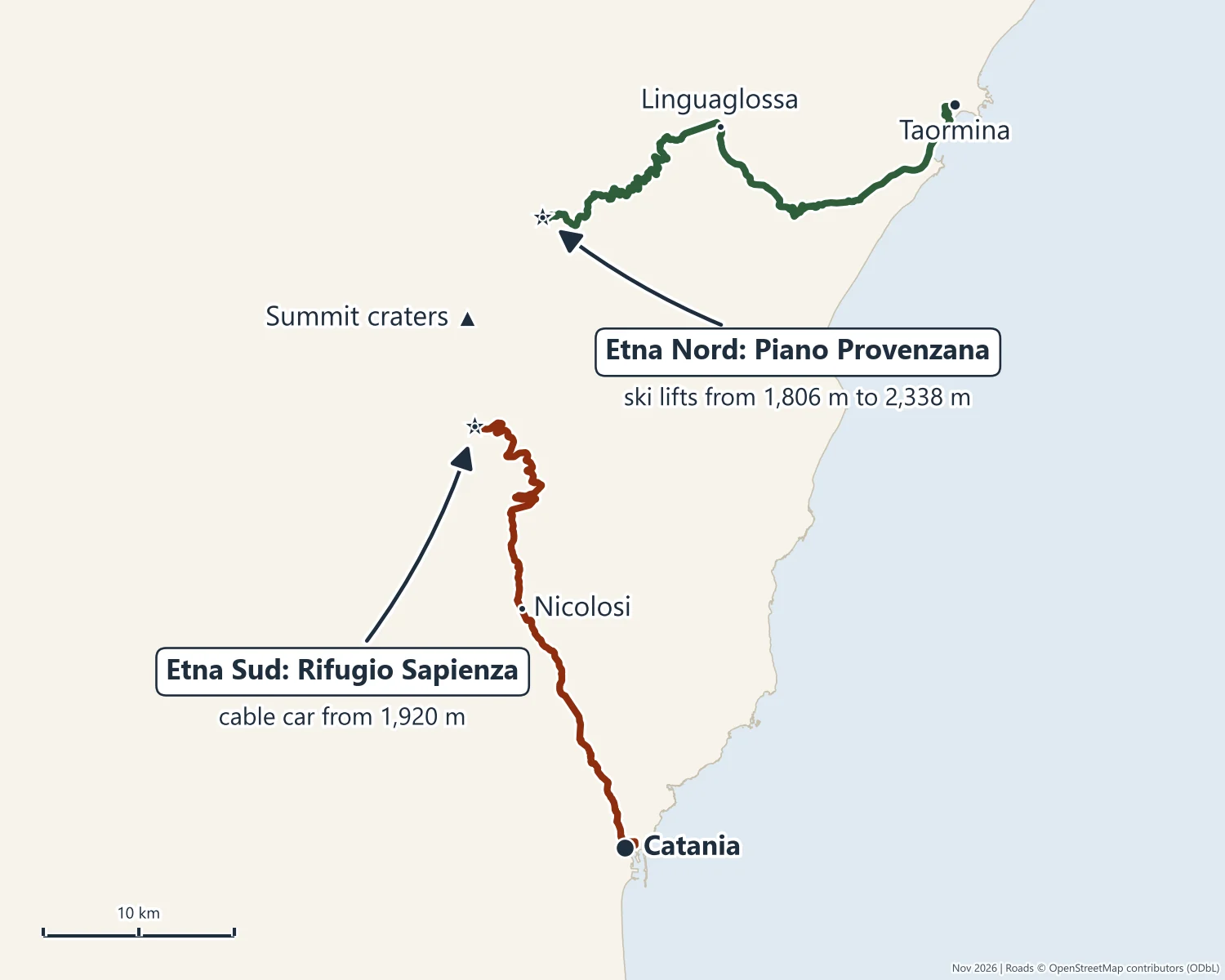
Yes, on the north side. Etna Nord at Piano Provenzana, above Linguaglossa, has four lifts run by STAR Etna: the Pouchoz–Tanaurpi chairlift on the easy run (1,806 to 2,001 m) and three drag lifts on expert runs, Monte Conca, Coccinelle and Anfiteatro, the last reaching 2,338 m. A moving carpet serves beginners. To ride them you need third-party liability insurance, which Italian law (D.Lgs. 40/2021) makes compulsory on the pistes, and an approved helmet. STAR posts its webcams online; on 4 November 2026 its site marked the 2025/26 season as closed and gave no opening date for 2026/27.
Etna Sud at Rifugio Sapienza is the cable car side. The Funivia dell’Etna runs the only cable car on the volcano, from its 1,920 m station to 2,500 m, and in winter a snowcat takes over from the 4x4 bus between 2,500 and 2,800 m. Its site sells the cable car and the Tour 3000; it publishes no ski season, lift list or lift status for the south side for 2026/27 (checked 4 November 2026). So a ski day on Etna, as far as anyone publishes one, is a north-side day.
When is there snow on Etna?
In the last full winter, from January to April. In the weather model behind the strip above, the winter of 2025-26 brought no snow cover to either station in November and only traces in December. Heavy snow arrived in January 2026, and from February to the end of March 2026 at least 20 cm lay at one station or both every hour; snow still covered the south station on most April days. In the same model the first snow of the 2026-27 winter, about 8 cm, fell at Rifugio Sapienza on 2 November 2026.
The strip reads only the two stations, where people start walking or skiing; the summit craters rise more than a thousand metres above them. The north side treks plan for snow from December to March: that is when the 2002 craters trek rents out snowshoes.
What to wear on Etna in winter
Dress for a mountain, not for Sicily. Warm layers, a windproof jacket, gloves, a hat and hiking shoes are the kit list on the winter tours, and the north-side treks do not supply gloves or hats, so bring your own. Sandals and open shoes are not allowed on the lava. Above the stations a helmet is part of the rules: Belpasso ordinance 135 of 10 August 2026 requires mountain clothing and an approved helmet from everyone at high altitude on the south side, and the summit winter trek includes one.
Driving up in snow
From 15 November to 15 April the provincial roads toward both stations require winter tyres or chains in the car, under the Città Metropolitana di Catania’s rule: among them the SP 92 from Nicolosi past Rifugio Sapienza to Zafferana Etnea, and the SP 59 from Milo to Linguaglossa, which meets the Mareneve road up to Piano Provenzana at Fornazzo. On snow or ice the chains go on at once, even outside those dates. After heavy snow the same body closes mountain roads by ordinance: on 26 January 2026 it reopened the old Mareneve road from Fornazzo to the Piano Provenzana junction, closed four days earlier. On the north side the snowshoe trek can bring its meeting time forward to 8:45 or 9:00, because skiers fill the car park at Piano Provenzana.
Check it yourself
- STAR Etna’s webcams at Piano Provenzana, for the north side’s snow and the lifts.
- The Funivia dell’Etna for the cable car and the Tour 3000 on the south side.
- The Città Metropolitana di Catania’s winter road rule, and its ordinances when a road closes.
How the strip reads the snow
The strip asks a 2.2 km Italian weather model (ItaliaMeteo ICON-2I) for the snow depth at two points each time the page opens: Rifugio Sapienza, at the cable car’s 1,920 m, and Piano Provenzana, at the 1,806 m foot of the ski lifts. It takes the deeper of the two. Snow up top means 20 cm or more at either station; a dusting means 2 to 20 cm, or fresh snow in the last three days; no snow means under 2 cm at both. Over the winter of 2025-26 the deeper station held 20 cm or more on 52% of hours, 2 to 20 cm on 13% and less on 35%. It is a model estimate for the two stations, not a measurement and not a lift report: the webcams above show what is on the ground.
Snow on Etna: questions before you go up
The cable car, the roads and the rules in winter.
Yes, and above it a snowcat replaces the 4x4 bus. The Funivia dell'Etna lifts visitors from its 1,920 m station to 2,500 m; on the Tour 3000 a 4x4 bus covers 2,500 to 2,800 m in summer and a snowcat does it in winter, then a volcanological guide walks the group toward 3,000 m. Wind or the volcano can still stop the line on a given day. The cable car tickets and tours.
From 15 November to 15 April you need winter tyres or chains in the car. The Città Metropolitana di Catania sets the rule on the provincial roads at risk of snow and ice, among them the SP 92 from Nicolosi to Zafferana Etnea and the SP 59 from Milo to Linguaglossa. Outside those dates it applies whenever there is snow or ice, and on a snowy road the chains go on at once. The same body closes and reopens mountain roads by ordinance after heavy snow.
A ski pass, third-party liability insurance and an approved helmet. STAR Etna, which runs the Etna Nord lifts, requires insurance under Italian law (D.Lgs. 40/2021) and a certified helmet for everyone on the pistes; the policy can be bought online before you go. Passes are sold at the ticket office and through STAR's online shop.
Only with a licensed guide, as in summer, and only while the alert phase allows it. Belpasso ordinance 135 of 10 August 2026, in force with no end date, lets people into the permanent danger zone near the summit craters only with alpine or volcanological guides, at most ten per guide, with mountain clothing and an approved helmet. A pre-alarm closes that zone and an alarm closes everything above 2,500 m. Snow and ice add the guide's own call on the day.
Still have questions? Email us at info@mount-etna.tours